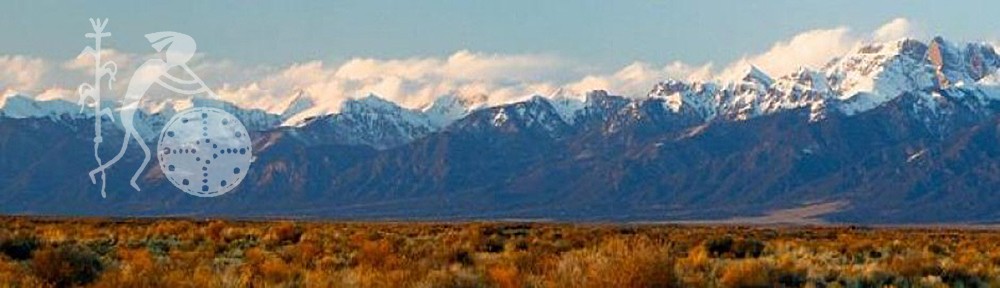
 Chaco Canyon National Historical Park is one of the most amazing power spots in the American Southwest. Planned and constructed in stages between AD 850 to AD 1150 by Native American Pueblo people, this was the center of the Chacoan world. That world eventually covered a vast area of the present-day Southwest, including the San Juan Basin of New Mexico, and portions of Colorado, Utah, and Arizona. For over 300 years, Chacoan Culture united many diverse peoples within its sphere of influence.
I have taken countless number of EarthWalks individuals and groups to Chaco, including corporate team building experiences as well as many people seeking solitude and a way to tune into the Spirit of Place. Chaco is remote, quiet and yet filled with voices of the ancient ones who built this amazing architecture. In fact, their work was highly advanced.
The Ancient Pueblo Peoples, also known as Anasazi, observed and recorded celestial phenomena. Two well-known archaeoastronomical sites are found in Chaco. The Sun Dagger in Fajada Butte is a celestial calendar that marks the equinoxes and solstices by projecting sunlight on a spiral petroglyph.
The 1054 supernova pictograph is thought to record the sighting of the supernova that originated the Crab Nebula in the year 1054 CE (also recorded by the Chinese), as well as the visit of Halley’s Comet a few years later.
We are about to mark the anniversary on February 24 of the Supernova of 1987. While primitive humans of the Middle Paleolithic hunted prey and sheltered in caves in Africa, a distant star eighteen times more massive than the Sun, located faraway in the Large Magellanic Cloud (LMC) endured a catastrophic collapse as it reached the end of its life. As the star caved in, its outer layers rebounded off its dense core and blasted outwards, ripping the star apart in a supernova. Some 160,000 years later the light of this supernova, travelling at 300 million metres per second, finally reached Earth to shine in Southern Hemisphere skies on February 24, 1987.
There are many, many examples of special astronomical alignments in the Chaco architecture which I will share in future blogs.
One one particular EarthWalks, I was leading a group from the Institute of Noetic Sciences. As we drove into the Canyon it began to snow. However, a few intrepid souls and myself decided to brave the cold wind and weather and make our way to the Great Kiva at Casa Rinconada. As I sat there, eyes closed in quiet meditation, I felt a distinct warmth around me and a inner vision of bright light. It dissipated after awhile, but not the feeling that I had experienced something very powerful. Later that night at our hotel, the group members who had gone with me reported that independently they had the same experience.
A visit to Chaco can be challenging, transformational, never to be forgotten and frustrating. Weather is variable, the road into the Park unpaved, only camping is available and it extremely dry in wide open space. But having said all that, I highly recommend a visit to Chaco. Come with reverence and respect and be prepared to listen into the Great Silence. You just might hear what you need to hear and see what you need to see. I can provide you with more information or help you create a special journey to this amazing site or other places in the American Southwest and Mexico.
If you are more interested, contact us at info@earthwalks.org.